Thursday, May 2, 2019

Camino: Zabaldika to Cizor Menor

02/05/19
After leaving the tiny church in Zabaldika, I traveled through the largest city on my Camino, Pamplona, with a population of 200,000. After bucolic countryside, the city seemed harried & hurried, albeit beautiful, with its historic walled city, Cathedral Santa Maria el Real, gardens, many plazas & cafes, & the allure of treading the path used for running of the bulls in the annual Fiesta de San Fermin (the event draws over 1 million folks annually.) Spanish cities & towns are cleaned each night & sparkle in the empty early hours. It's a magical time to be quietly plodding through a medieval town. With a reservation confirmed I had ample time to sit with a cafe con leche in a Hemingway haunt on the lively Plaza Mayor. As a little sweet goodbye, I enjoyed considerable time in a wonderful city park & garden on the outskirts of Pamplona.

I continued ahead to Cizor Menor to get a jump on the crowds for tomorrow's big day to Alto del Perdon. It was a nice treat to have a full but same sex room- promising less snoring & better hygiene. I walked alone into the only restaurant in town & was immediately adopted by two adventurous couples who turned out to be some of my favorite people along the trail.
14K to Cizor Menor (population 2200)  + 10K in Pamplona

A view from historic Cafe Iruna in Plaza Mayor, Pamplona

Pamplona in a quiet moment


An ode to the running of the bulls


Wednesday, May 1, 2019

Camino: Zubiri to Zabaldika

01/05/19
A bright sunny day leaving Zubiri. The kind of day that urges you to take your socks & shoes off & linger longer at a sunny cafe. Unfortunately, no rest for the weary. I had plans for this day! Big plans!

Staying with the sisters at the convent in Zabaldika came highly recommended & turned out to be a highlight of the trip. It was my first stay that didn't allow for reservations so I was a speed devil to get to the convent to secure one of the 18 coveted beds. I ended up with the first bag in line (pilgrims highly respect the bag line at aubergues) so while waiting for the convent to open, I had time to journal and do a bit of painting. Following a tasty communal meal, we adjourned to the church belfry for an evening of song, prayer & sharing with fellow pilgrims.

13K to Zabaldika (population 400)


These are green post it notes filled with pilgrim wishes for prayers by the sisters.

A bit of an overachiever... first in line for a bed


Tuesday, April 30, 2019

Camino: Roncesvalles to Zubiri

30/04/19
After clearing the Pyrenees & Roncesvalles, I wasn't prepared for the tough downhill & rocky slog to Zubiri. Somehow you get it in your head that the Pyrenees are the tough days you have to prep for, but it's just the first challenge in a long adventure. The small wiggly rocks were unstable & required poles & careful foot placement for mile after mile. I was so glad to cross the Puenta de la Rabia bridge (named for the belief that if animals were led over the bridge three times they would be cured of rabies) into Zubiri & spend a few moments enjoying the icy cold of the river on my hot & tired tootsies. Here I met Mr. Blister, a fellow with a pair of particularly gnarly feet. 
I stayed at a lovely aubergue, Suseia, with a communal meal and grassy courtyard that served as my outdoor yoga studio. My yogi, Caryn, would be proud
.
22k to Zubiri (population 400)


Aubergue Suseia


Monday, April 29, 2019

Camino: Orisson to Roncesvalles

29/04/19
Still in France, I moved on from the homey Orisson aubergue. Aubergues are the Spanish word for shared communal living quarters, typically with bunk beds and shared shower quarters. These are particularly useful as a way of getting to know other pilgrims. Orisson is a favorite as it hosts a communal meal with a "sharing" session to meet over 50 fellow travelers. It is the only housing on the way over the Pyrenees so reservations are critical. I lost count of all of the countries folks at dinner were from. We had a couple from Idaho in their 60s, here on the honeymoon. One gentleman, Carter is turning 80 & his five children will be taking turns joining him on the Camino. There were lots of newbies like me & seasoned pilgrims with many Caminos under their belt.

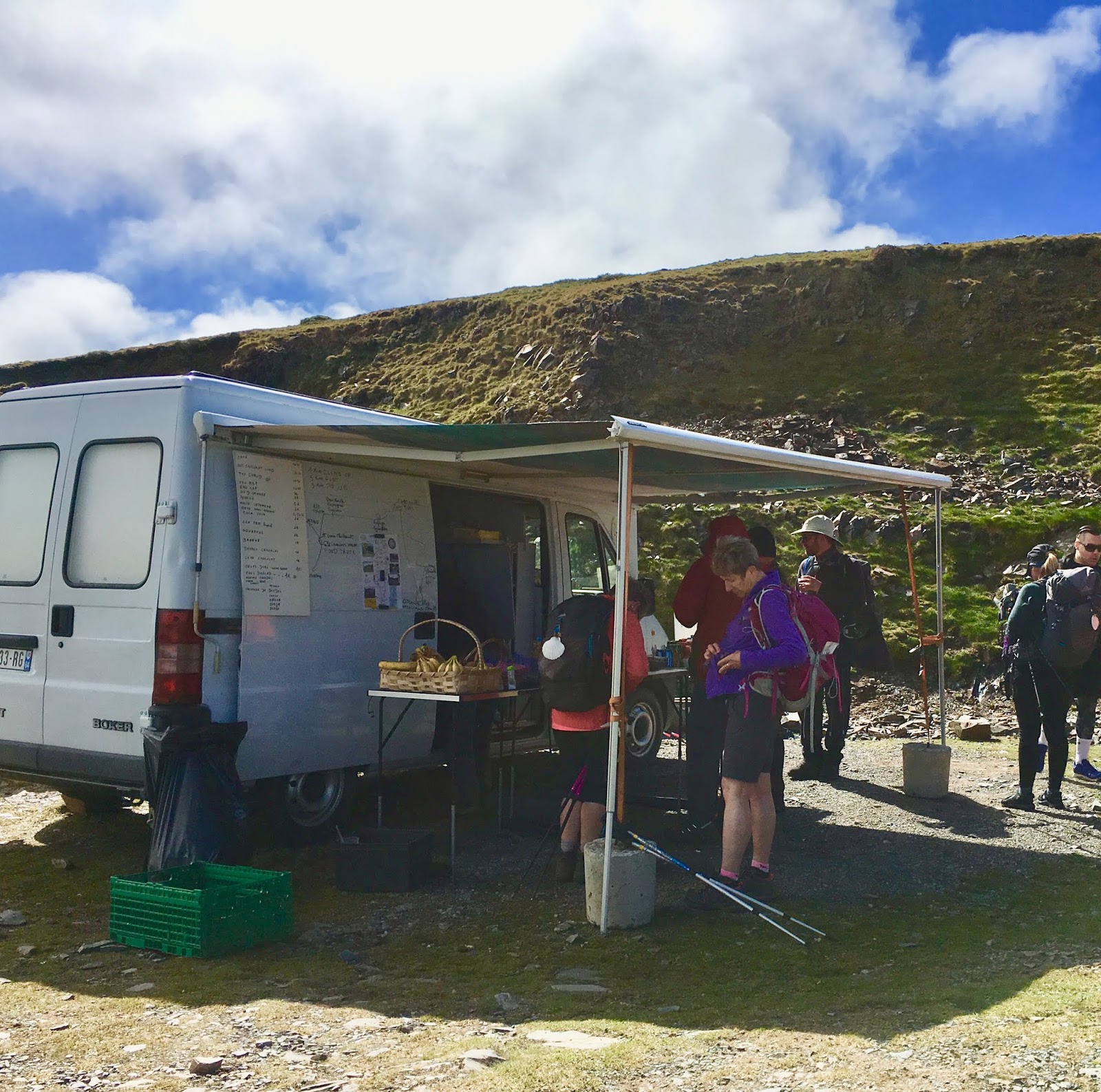
The next morning weather conditions were good so we were able to cross the Pyrenees via the particularly scenic Col de Lepoeder approach (altitude 4757 feet/ 1450  meters) with a particularly dicey downhill. Just days before & after, the path was closed due to snow and wind & travelers had to be rescued from the mountain. With spectacular views, wildlife & even a food truck with steamy hot chocolate, it was a challenge but quite doable with careful footing.

18k with lots of altitude change to Roncesvalles (population 30). 


A chilly start

Snow angels


Well-deserved cervesas


Sunday, April 28, 2019

Camino: SJPdP to Orisson

28-04-19
My Camino begins in the quaint village of St. Jean Pied de Port (population 1500), the traditional starting point of the 800k/ 500 mile Camino Frances. First stop, the efficient Pilgrim office. Kind volunteers will set you up with aubergue contact information, elevation maps & provide your new best friend, your credential! They even have a big scale if you want to see how good you were at whittling down the weight of your pack. We must look like school children on our first day of class- jittery, nervous smiles & tons of questions. 
My lovely aubergue, Beilari, included a get-to-know-you session at the communal dinner- a perfect opportunity to make new friends. There are those nervous moments at night when you check the weather for the umpteenth time & give your pack a final once-over to be sure you haven't overlooked anything. Then, a feeble attempt at sleep until we were awaken by soft choir music. After a Sunday Basque mass, our "Camino Family" began our hike. 

I elected to stop overnight in Orisson, about halfway up the Pyrenees to break up the arduous first day. A smart choice as weather was crisp & clear so views from the Orisson deck were spectacular & cried out for a celebratory beverage. Still an aubergue newbie, I met my new seven bunkmates for the evening. I had heard that bottom bunks are often offered to the older or injured pilgrims. I was glad to be assigned to the top bunk- ha! After a bit of work to get a too-tiny single-use sheet onto a mattress, I settled into my bunk with all the gear I may need overnight, headphones in place to cover snores from those lower bunks. Next day- do it all again, except we tackle the Pyrenees climb to Roncesvalles on Day 2.
8k to Orisson


My own special Camino shell


The welcome at Beilari, my first home on the Camino
Views from the Orisson deck

Saturday, April 27, 2019

HOW- The Camino

There are as many ways to do the Camino as there are paths to Santiago de Compostela. 
Many pilgrims, assured that “the Camino will provide,” embark with minimal planning & no booked lodging. This approach does indeed allow for serendipity & flexibility to stop where & when you tire, but can also lead to racing for limited bed space in many first-come, first-serve aubergues or an end-of-day unplanned walk to the next town seeking shelter. As anyone who knows me knows, I’m not a “wing it” sort of gal. Some may call it “anal”- I prefer “ serving myself up for success.” I get enjoyment reading about my travels as I plan- hunting for perfect spots along the way. I know I need daily goals & that I will have a spot to look forward to & call home each evening after a long day on the trail. 

For the Camino, this has meant countless hours with fellow Camino friends & patient REI staff contemplating the virtues of boots vs. trail shoes, rain jackets vs. ponchos (apparently this is a very heated Camino subject) & the sexy topic of foot care. 

They say you carry your fears in your pack. I must be deathly afraid of blisters & starving. My day pack happily houses a wide assortment of high-tech bandages, tapes, goos & my personal favorite, silicone toe condoms. I admit to wearing a pair as I type. I also have some Camino treats- Kind bars, gummy bears & even a few easter candies. My other fear appears to be chinches- bed bugs, as my gear has been doused & sprayed with repellent to make me the least attractive pilgrim in the aubergue. 

Packing for the Camino is an art. With back issues, I’ll be sending ahead a pack with sleeping gear & such, but each pilgrim needs to carry on their back what they need for each day. Experts recommend a pack goal weight of no more than 10% of your body weight (finally that extra layer of winter blubber pays off!) With pack & water weight of over 5 pounds, it’s tricky to fit in cold weather & rain gear, a first aid kit, food, camera/phone, electronics & anything you want to keep safe & aren't willing to part with.  

As a single traveler for the first few weeks, every late night visit to the bathroom or post-hike shower requires bringing a waterproof sack of all your valuables from electronics to passport, in with you to the bathroom. I’m hoping to score a few lower bunks as I will be sleeping with these items in my sleep sack. 

So by now you’re asking, “And why are you doing this.” I’ve never been one to shy away from a challenge or adventure & the Camino promises to provide a blend of physical, mental & social elements. All this on a backdrop of bucolic scenery full of pilgrims all headed in the same direction with a common goal. Fellow pilgrims frequently hike in & out of your life throughout the journey, forming your “Camino family.” Folks report of joyous greetings as they reconnect with friends met earlier on the path. We'll gladly see what lies ahead. Wish me "Buen Camino."


Wednesday, April 24, 2019

WHY the Camino?

Why the Camino?
They say the Camino is part physical, part mental & part spiritual.

Pilgrims, as Camino travelers are called, come from all over the world and put themselves through physical hardship, subjecting their body to the rigors of walking between 25 & 30km a day –day after day.  At a glance, the Camino is not physically overwhelming- hiking/walking is putting one foot in front of the other. The challenge is putting those feet in front of each other hour after hour & day after day. No stopping for snow (yes, snow), wind, rain, wind or heat (kind of like the USPS.) Ignore those blisters and sore muscles. The 40+ days of bodily stress and repetition are difficult to truly train for & many pilgrims are plagued with injuries along the way.

Mentally, pilgrims report the Camino is often mesmerizing in its simplicity. The daily ritual of putting on your gear, following yellow arrows for miles on end, arriving to your bunk to shower, do a bit of laundry & enjoy communal meals with pilgrims at each day’s end, allows time for reflection & thought. Minimal technology & news = nirvana. You tend to your physical needs, wake up & do it all again, God willing. Others find significance in the paring down their possessions to live simply using just the items in their pack. Most past pilgrims tell tales of bringing too much “stuff” and end up donating it or sending items ahead when they realize how little they need to survive on the Camino.  The ubiquitous saying, “The Camino will provide,” provides a soft blanket of support for the pilgrimage.

While all pilgrims travel a similar physical path kilometer after kilometer, each travels another spiritual or internal path, which is personal and unique.  In addition to the connection with nature that the Camino provides, the anonymous nature of the pilgrimage often strips away labels and conventions of society to create a sense that all pilgrims are the same & are supporting each other in a common quest. Pilgrims are encouraged to make their Camino what they need it to be for them- going the speed, distance or path that works best for them. By providing the time to reflect and reconnect to themselves, pilgrims often experience personal transformative change that goes beyond a simple hike.

Tuesday, April 23, 2019

WHAT is the Camino de Santiago

Many of you have asked me, “What is the Camino- and why in the world are you doing it?”

The Camino de Santiago is a network of pilgrims' ways or pilgrimages leading to the shrine of the apostle Saint James the Great in the cathedral of Santiago de Compostela in northwestern Spain, where tradition has it that the remains of the saint are buried. Many
follow its routes as a form of spiritual path or retreat for their spiritual growth.  Travelers can take one of dozens of pilgrimage routes to Santiago. Traditionally, as with most pilgrimages, the Way of Saint James began at one's home and ended at the pilgrimage site. However, a few of the routes are considered main ones. During the Middle Ages, the route was highly travelled. However, the Black Death, the Protestant Reformation, and political unrest in 16th century Europe led to its decline. By the 1980s, only a few hundred pilgrims per year registered in the pilgrim's office in Santiago. In the ‘80s, the route was named a UNESCO World Heritage Site. Since then, the route has attracted a growing number of modern-day international pilgrims- over 250,000 begin the journey annually. Many choose to complete the entire 800km (500 mile) CF route, while others break the journey into shorter pieces to complete their pilgrimage over several years.

Imagine if you will, simple pilgrims making this arduous journey since the 8th century. Pilgrims today continue this same spiritual and physical journey- albeit now in wicking garments and high-tech hiking gear. The path is now regularly marked with yellow arrows pointing pilgrims toward Santiago.

In Spain, France and Portugal, pilgrim's hostels with bunk beds in dormitories provide overnight accommodation for pilgrims who hold a credencial (a pilgrims’passport of sorts). These aubergues (as they are called in Spain) may be run by the local parish, private owners or pilgrims' associations.  With the growth in popularity of the Camino, many small family-run inns also dot the path. Your pilgrim credential provides access to accommodations along the way and must be stamped daily, serving as proof to the Pilgrim's Office in Santiago that you accomplished your journey to receive your compostela (certificate of completion of the pilgrimage). Pilgrims who have walked at least the last 100 km (62 miles), or cycled 200 km (120 miles) are eligible for a compostela.

Sunday, May 13, 2018

Getting By in Cuba


The Cuban people still remain resilient and hopeful amid changing political and economic circumstances of which they assert no control. With an average monthly income of approximately $20/month, yet the highest literacy rate in the Americas, many of the most educated Cubans make more in the tourism industry than as engineers or educators.

With embargoes and lessened support by past allies Russia and Venezuela, rations are a part of everyday life for Cubans. Carefully controlled Libreta de Abastecimientos (supplies booklets) indicate maximum amounts of basic foods each Cuban can purchase- if the goods
Availability & prices
posted in bodegas
are even available. Our friend, Gaby, shared how difficult it is to follow a recipe as chances are high that one or more ingredients will be unavailable. Consequently, Cubans spend a lot of time in line. Word spreads when items are available and trading is the best way to secure necessary supplies.

I’m not sure if it is because of the country’s socialist attitude or years of paternal government care, most Cubans seem to pleasantly and diligently go about their lives without the sense of aggressive urgency that you see in other nearby islands like Jamaica. But pockets of entrepreneurship are appearing. Casa Particulares, privately-owned B&Bs often part of individual’s homes, are popping up daily and private restaurants often offer the best meals you’ll enjoy during a stay. This also allows you to direct funds to residents rather than government agencies- a major tenet of the latest US restrictions for tourists.
The US Embassy in Havana

With media control, ingenious Cuban’s get their entertainment and news through “the package”. The Package is a weekly data delivery of an odd assortment of media for consumption by Cubans. Perhaps “Game of Thrones”, “House of Cards” or “The Bachelor”- who knows what the selection criteria is for The Package. Some pick up the weekly thumb drive of data at a nearly local bodega. Another cottage industry has a young techie coming to homes to install the data onto laptops for home consumption. Most households have an established system whereby they can widely share The Package and share the costs among several families. I guess it is a lot like Netflix passwords, isn’t it?

Heavenly Havana


I absolutely adore Havana. 

Five centuries of history have helped shape this electric and culturally unique society. A stomping ground for pirates, a slave port for the Spanish and later a gambling capital for the American mafia, Havana has survived it all and retains the glimmer of her former grandeur. The city has given the world salsa, cigars, rum and mojitos and still shares these riches with visitors. It has the feel of a Spanish New Orleans without the frat boys. Historic and slightly seedy. Women in brightly colored dresses and cigars are ready to share a photo for a fee. Latin music lilting as you gingerly walk down narrow stone streets. She has the feeling of a former beauty who continues to put on her best dress and present herself proudly even though time has taken a toll on her splendor.  Peel back the façade of most ornate buildings and you’ll encounter roughly patched plaster and a nest of unruly and slightly frightening electric wires. In fact, an average of four buildings collapses each day in
Cuba. Not through shoddy workmanship but through sheer lack of maintenance and upkeep. Amid the deteriorating buses and share taxis used by local commuters, over 150,000 Classic American cars still troll the roads of Cuba in search of tourist fares. Since parts have been unavailable since the 1959 embargo, ingenious Cuban mechanics have kept the cars- and their source of income- in working order through creative work under the hood. A highlight of any trip to Havana is a ride down leafy boulevards sporting your new straw hat in a pink ’53 Cadillac convertible.

Perhaps my favorite spot is the Malecon, Havana’s long waterfront promenade. Cuban friends tell stories of how their parents met and courted on the Malecon. Today the path continues to be an important meeting spot for Cuban youth who don’t have gaming, Netflix and endless wifi to serve as their entertainment.

Another of my favorite spots that we shared with friends is the nearby Jaimanitas neighborhood and its highlight, Fustelandia. As a writer, I find words difficult to describe this sprawling home where every inch is covered with mosaic. We’re not talking Gaudi Guell Park in Barcelona mosaic, but if the cat stood still, he would have grout and broken plate parts all over his back. Whatever happened to hit the artist Jose Fuste’s fancy each day was the object of his next project using whatever local plates he could find. The three-floor edifice includes giraffes, mermaids, Virgin Marys and countless other mosaic subjects.

The Anachronism that is Cuba


I’ve always loved the energy of our Cuban friends. I love the fact that they can’t talk without using their hands, fall easily into laughter and will dance at the drop of a straw hat. How could they have such obvious lust for life when I’d heard their family tales of growing up, facing repression and ultimately escaping their homeland? This is part of why I felt the strong draw to see this island before it became the Miami Beach of the Caribbean.

We’ve now been twice. Our first visit was during the questionable days when flights were
unavailable directly from the US and group “People-2-People” educational experiences were
the only way to visit. We were so befuddled, mesmerized and intrigued by it that we recently returned with six friends to share this perplexing island before travel restrictions were once again tightened. I’m not sure what I can definitively say about Cuba even after several weeks on the island. I still scratch my head as I did before I first stepped foot on its soil.

As a former Spanish colony painted with French, African, American and Jamaican influences, the breadth of Cuba’s heritage is staggering. Historical heirlooms- forts, palaces, plazas and colonial towns- dominate the landscape. You can easily understand why it was the object of desire for pirates and explorers alike. The people of Cuba have kept the country’s effervescent, seductive culture alive for centuries, revering their poets, writers, musicians and dancers. Cuba remains a paradise and an anachronism in a world that has become ever-more globalized.

It’s hard to ferret out the truth as those you meet share the “party line” on the brave resistance fighters who saved them from the corrupt Battista regime. To me, the question remains which is the lesser of two evils and what lies ahead now that Raul Castro has stepped down. Guides tout the country’s medical and educational system, low crime rate and lack of drug use.  Lack of resources and even basic food items, low wages, inadequate housing, corruption and minimal opportunity for advancement paint a different picture.
The dual currency system also leaves me scratching my head. Since credit cards and ATMs
aren’t available in Cuba, visitors must come laden with cash for exchange into CUCs- Cuban Convertible Pesos. These mirror the dollar except for the 13% exchange rate levied on US dollar exchanges and only US dollar exchanges (a final little F-U from the Castros?) Locals use CUP, Cuban Pesos, so prices are posted in both currencies, although goods for locals are heavily subsidized for those lucky few who can afford them.

What lies ahead? With our mercurial leadership, we opted for trip insurance for the first time in our lives- not out of fear of storms or family illness, but out of alarm that the US may close access before our trip. Travel sanctions actually increased while we were in-country but did not affect our return. Yes, you can still visit Cuba at this time, but are restricted from financially supporting government-owned facilities and businesses.

I certainly wouldn’t want to be the owner of one of the expensive People-2-People tour licenses. I can only equate the situation to that of a NYC cabbie holding a taxi medallion, watching as Uber and a myriad of providers chip away at his profits. If Cuba continues to open up as is expected, the day may ultimately come when Americans can come and go at will, enjoying luxurious hotels and white sand beaches, outside the confines of P2P programs.  Or maybe not?

Midnight at the Oasis


I can’t say enough good about this lovely country and its people, but like its ubiquitous mint
tea, Morocco is an acquired taste and one you must share a while with a local to fully enjoy its full flavor.

Even before landing, we were struck by the verdant beauty of the country- not what we had imagined from years of Sahara desert films. The country produces tasty figs, olives, fruit and dates- all creatively and precariously displayed in local medinas.

Each city maintains its own unique qualities and sensibilities. But regardless of where you travel, you’ll see new highways and construction alongside historic mosques, ruins and fortresses.

Rabat, Morocco’s political capital, is a city going on about its business. While quite walkable with history readily on display, tourism takes a back seat to running the country and educating its people. 

Fes is an antidote to your daily life. In its sprawling Fes El Bali medina, the world’s largest car-free urban area, it’s virtually impossible to keep a sense of direction or time. In fact, it best to allow yourself to be transported by the scents and bedlam of the medina. Put away your map and arm yourself with a camera and small currency and prepare yourself for an assault to your senses.  Moroccans have never heard of the grid system. With miles of chaotic stalls laden with produce, leather and linens, there’s nary a name for a lane or anything resembling a straight path. Yells of, “Belak, Belak” warn you to quickly step to the side of your path to avoid an unfortunate crash with a burro delivering goods. Carpet stores greet you with tea and small talk before the world’s best salesmen share their fine rugs with a muffled “thump” as each carpet is rolled out and you are urged to feel the quality of each piece. Somehow they can pack a full-size carpet into a bag no bigger than my toiletry bag. Follow your nose to the Chouara Tannery where workers use traditional techniques to dye hides, constantly stirring to ensure they evenly accept the vats of color. Here we stayed in Riad Salaam Fes, a “repurposed” palace now serving as a sumptuous boutique hotel and restaurant. 

My favorite city, Marrakesh, is part P.T. Barnum and part oppulent riad hotel. Outside the medina, car traffic seamlessly melds with horses, scooters and taxis. Camels are parked and waiting outside the local mall. Inside the labyrinth of the medina be prepared for anything. Small souks and food stalls are nuzzled between snake charmers, henna painters and my favorite, the local dentist, proudly displaying the hundreds of sets of dentures, all waiting for your chomping pleasure.  Marrakesh, the city of Ochre, is ready and waiting for its sophisticated visitors. Behind even the most unassuming door often stands a lavish riad with a citrus-laden garden and top-rated rooftop restaurant.

I’d never even heard of the seaside hamlet of Essaouira but after a day wandering the fishing village, you can see why Moroccans gather here for holiday to enjoy the relaxed attitude, salty breezes and fresh seafood.

But the star of Morocco is the Sahara. It’s been the stuff of dreams since Casablanca and Indiana Jones films. It’s now a popular film production location due to low cost and ready production sets. As we neared the desert, we encountered goats perilously perched high in trees to enjoy hard-to-reach tasty Argan nuts high up in the trees. A highlight of our adventure was an overnight stay in a Berber tented camp. After a sunset camel ride, it was special to take in the stars without city light polution. Hot water bottles and heavy carpets awaited you in bed to keep you cozy on the chilly night.

Although we travel often, I was surprised how little English was spoken. This goes back to the fact that Morocco was once a protectorate of France and that currently, Muslims and the nomadic Berbers live side-by-side. Signage typically includes Arabic, Berber and French. I was also admittedly surprised by the open kindness and humor of the Moroccans.  Even in the busiest medina where I was often lost and cried out “tourist” with my blond hair and pastel clothes, vendors used my map to point me in the correct direction. Even in a busy urban Casablanca neighborhood, when I asked where I might find a particular item, a shopkeeper had one of her staff walk me to a nearby store in hopes of finding the item.

To quote a famous person (OK, Jeff Blakely), if Morocco is on your bucket list, don’t wait. If it’s not, consider adding it. And go now!

Our adventure was featured in a marketing video of Morocco. If you are considering a trip, it is well worth a few moments of your time and prominently features my co-star, Jeff. Take a peek.

Wednesday, February 3, 2016

BA: Paris of South America?

It's easy to see why Buenos Aires has the moniker, "Paris of South America."  In fact, several of its parks and important buildings were designed by Parisians.
No other major city (greater BA boast of 15 million residents) has allotted so much space to parks, trees and promenades. Its buildings have the majestic air of those in the Marais and statues and art dot the city's unexpected green spaces. As I strolled the cobblestone streets I didn't know whether to hum "LA Vie end Rose" or "Don't Cry for me Argentina."

But BA has successfully married history with modern necessities that actually work- and work well.  With its wide avenues (typically 8 lanes or more), clean subways & a vast network of bike lanes, you hardly hear a horn during peak hours.
portenos, the name for the locals, are a lively bunch and are fiercely proud of their traditions- soccer, polo, beef, wine (is it possible to have Malbec at every meal?) and importantly, the tango. Portenos visit late night milangas (tango bars), dancing into the wee hours, long after us tourists are hugging our pillows.

One thing that is odd is the queueing. Years of corruption and a revolving door of leadership has led to wild financial fluctuations. As such, ATMs at local banks only dole out a maximum of 300-600 pesos ($25-50USD) per day. Hence the long lines.
Gotta go- time for lunchtime Malbec. Don't cry for me, Argentina.

Monday, January 25, 2016

Patagonia: Land at the End of the World

Imagine the southernmost point of South America back in the 1500s. Explorers such as Portuguese adventurer Ferdinand Magellan were eager to find a way through the continent linking the Atlantic and Pacific oceans. He started his 2 1/2 journey in 1519 with three ships and 242 hearty souls. The sailing was hard
and dangerous work and ultimately many of the crew succumbed to hunger. By the time they had traversed the "Straits of Magellan" (hey, you find it, you name it) and crossed the Pacific, only one ship, the Victoria, and 18 crew members survived.

The region still requires a hearty soul to call Patagonia home. This  frigid region has only 150,000 residents sprinkled across its 150,000 acres. Brisk winds hammer endless plains of pampas grass while snow capped mountains dot the horizon. Here in the summer, we haven't seen a temperature above 45 degrees although sunlight lazily stretches toward 10pm. On the only major 2-lane road, you'll travel miles and miles before encountering a modest bodega for a toilet and simple but hearty meal.

What you will encounter are estancias. These massive sheep farms are the heart and soul of the region. Most stretch over 10,000 acres with an owner's hacienda, worker quarters and the core of the operation- the shearing shed. Lonely outposts are placed at the desolate corners of each ranch. Here, puesteros, the caretakers, live year round charged with mending fences and guarding the sheep from predators like pumas and foxes. This solitary existence has been known to drive puesteros mad and erodes their social skills to the point that they barely communicate with those who visit to drop off supplies.

Friday, January 22, 2016

Easter Island Today

The island, still the most remote location on earth, with over 1,850 miles to the nearest land, is is healthier position. A part of

Chile since 1888, 40% of the island is a National Park. More trees dot the land and regular flights and ships bring needed supplies and one particular treasured item- tourists. Close to 60,000 visit each year to marvel at the mystical moai. The Rapa Nui people remain loyal to their traditions, their families a their language while adopting newer behaviors like surfing, diving and eco-tours.

Who would have thought that the moai carved by the early settlers would end being a key to rebuilding a thriving civilization. I guess they do indeed bring good luck. 

The Decay: A Sad & Cautionary Tale

No one on the island ever thought their abundant resources would ever run out. So when it became apparent that all the trees were quickly disappearing (whether used for moving moai or cut for homes and boats) it was too late to take action. Without
boats to fish and resources for housing, the Rapa Nui  tribes
ultimately turned on each other and their monarchy. Many moai were toppled in efforts to make their rival tribes less powerful. Their population, once over 10,000 began to dwindle. Their religious norms went out the window and the Rapa Nui turned to an odd event to determine their leadership- the annual birdman competition. Each tribe selects one young male member to represent them in the competition requiring the competitors gather in Orango village to swim to a nearby island, climb a cliff wall to the top of the island, find a bird egg and safely ferry it back to the village. The first to accomplish this feat is named "birdman" and serves as leader for a year.

But, off in a cave nestled into a seaside cliff at the other end of the island, girls have been secluded for most of their young lives. They were taught by elders and kept in the dark cave so their skin remain light. A bride (or brides) are selected to be married to the birdman in hopes of delivering numerous offspring to add to the tribe.

As if deforestation, infighting and pagan rituals weren't enough, along came the Peruvian slave traders. Eager for workers in their mines, they took over 1,800 Rapa Nui and through disease and neglect, killed all but 150. Missionaries secured their return but by the time they completed the arduous journey home, only 15 survived. These survivors brought disease to the island, killing off all but 110 Rapa Nui. Once again, immigration of new settlers was key to their survival.

The Golden Age: Legend Has It...

...that Polynesian adventurers set sail around 1200ad heading east in search of a
heavenly island seen in dreams by their king. He set foot on Easter Island at Anakena Beach. The settlers learned to farm the rugged land and live off the bountiful sea. Life was good. More settlers came and they settle into tribes. Pretty typical story to this point. 

The came the moai statues. Rapa Nui tribes used the mountains of the Rano Raraku quarry to carve immense statues of their leaders and VIPs. Made from tuf, a soft rock, the moai were actually carved while still in the mountainside then "freed" and later moved around the island to permanent sites with their tribe. The moai were not "alive" until their eyes were carved on site. They faced their village to provide protection and symbolize fertility of land and people. 

The mystery of how the moai were moved is unknown to this day. How were the statues- over 1000 still remain- moved without machinery to their final resting places? Remember, these statues are as tall as 37 feet tall and weigh several tons. Were they laid down and moved using logs or wheels of some kind? Were they standing and nudged along by crews with rope? How were the heavy red rock topknots placed on the moai heads? The mystery remains to this day although theories abound.

PS: If you are thinking of visiting Easter Island, check out Easter Island Travel for exceptional tours.

Wednesday, August 19, 2015

Winterpeg: Winnipeg’s Evil Twin

Day 51   Mile 7103
Winnipeg, CA

The word for today is, “HARDY.”
Being a Florida girl, I think cold means pulling out my closed-toe Skechers or (gasp!) wearing my boots lovingly stuffed with paper & displayed in my closet (a throwback to my NYC years!) But Winnipeg has winters on steroids.

While we experienced lovely, kind, summer Winnipeg, “Winterpeg” reigns supreme throughout the cold, dark winter here. Much like Frozen’s Elsa who can’t help but leave ice and cold in her wake, Winterpeg covers the region in freezing winds and ice and drives mere humans inside to hibernate like heartier bears.  Seeing power plugs along parking areas, I assumed they were for “green” Canadians driving electric cars. But noooo. I was informed these plugs are to charge engine warmers so car oil won’t freeze and batteries won’t die during typical 40 degrees below zero temperatures. It took all the self-control I had not to yell, “Why do you people live here in the winter? Run, run while you are still not frozen in ice!” No wonder Homer Simpson threatens his family with, “That’s it! We’re all going back to Winnipeg.”

 But we fell for lovely “summer” Winnipeg.  On our brief stop, it was a lovely temperate night along the waterfront, called “The Forks” where the Red and Assiniboine rivers meet. Open-air cafees dot the shoreline as small boats shuttle folks from point to point. Miles of gardens, parks and flat trails- just perfect for running, walking and biking- line the waterfront.

While we were in, the Interstellar Rodeo was taking place. This waterfront music festival, one of many crammed into Winnipeg’s short summer season, draws thousands of visitors and an interesting mix of talent- all enjoying evenings of music under the stars. The festival offers eclectic cuisine and even wine delivered to your lawn chair.  Wines are paired with each particular musician.  For Sarah McLaughlin, perhaps some chilled light white?  While for Dwight Youkum, I’ve gotta think they’d pull out an earthy pinot noir or top shelf tequila shots. We’ve gotten into Cider while here.  I wonder who I should add to my playlist for cider?